Showing posts with label LinkedIn. Show all posts

Up all night: the LinkedIn Intern Hackday, Day 2

Update: the official photos, videos, and submitted projects are now available on the Intern Hackday site.


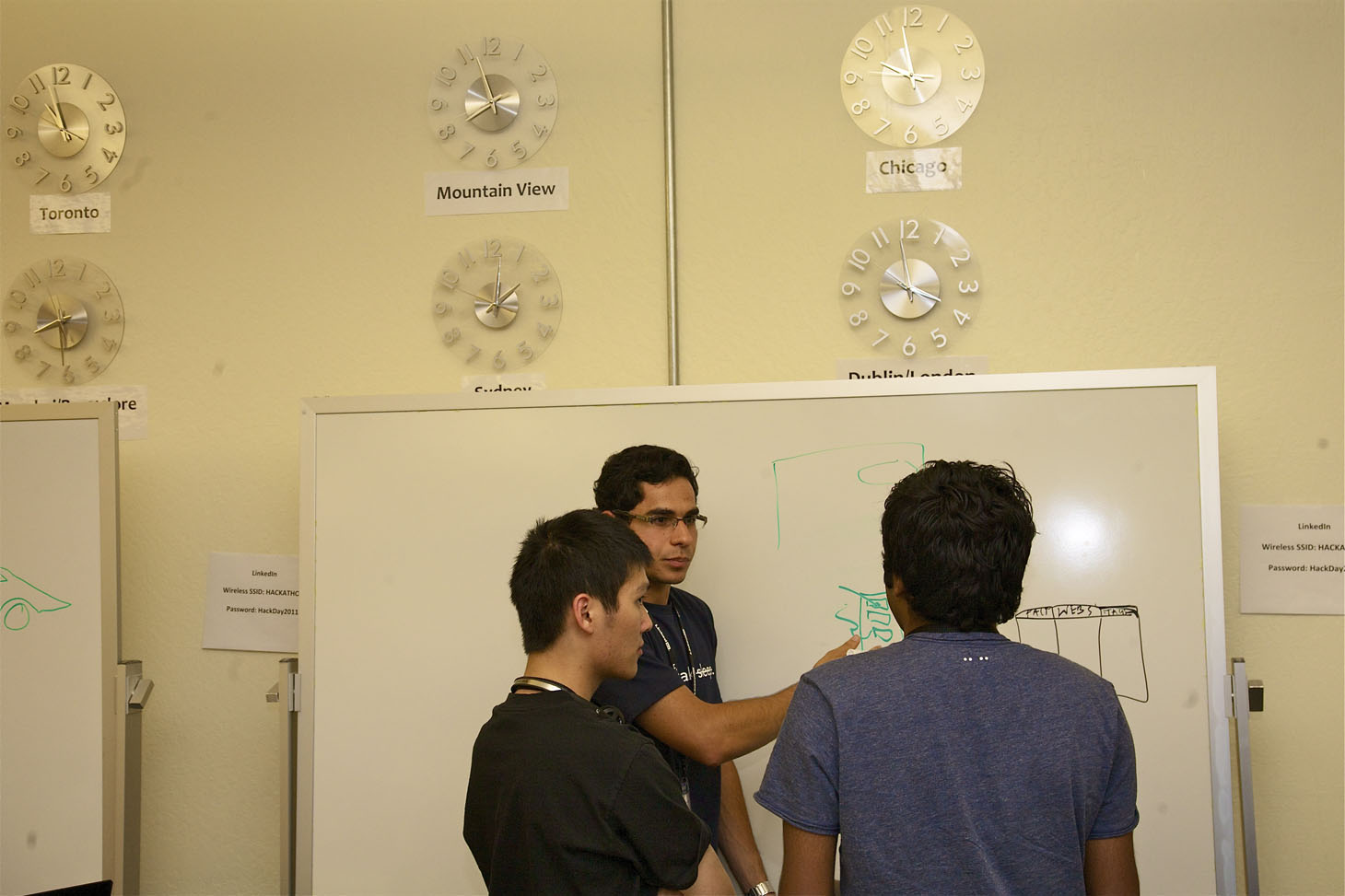
In my previous post, I showed you the sights and sounds from day 1 of the LinkedIn Intern Hackday. This post will do the same for day 2, Saturday July 30. The Intern Hackday was an overnight affair and just about all the interns worked straight through the night to get their hacks done by noon. 45 projects were submitted, featuring a wide range of ideas, platforms and technologies. We saw games, music apps, UI frameworks, augmented reality, AI, location apps, IDE extensions, p2p file sharing, and even a 20 page report.

The pictures below are, as usual, mostly from iPhones. Keep your eyes on the Intern Hackday site for the official event photos, videos and project submissions soon!

12:00am: one of the interns turns 21!
2:30am: Dylan Field gives us a preview of his team's hack
5:00am: the hackers are still going strong
Well, most of them anyway
Programmer, noun: an ingenious device that turns caffeine into code
6:30am: the sun comes up
10:00am: Brooke and her dog drop by to provide emotional support
11:00am: Allen announces the 1 hour warning
Less than 60 minutes to get the hacks submitted. Crunch time!
11:55am: 5 minute warning.
12:01pm: the hacks are submitted. Time to crash.
Sandwiched between bean bags
3:00pm: picking the 15 finalists
4:00pm: celebrity judges James Gosling, Kevin Scott and Omar Hamoui in the house!
Adam Nash kicks things off
The judges look on as some amazing projects are presented
Rocks: a 3d, in-browser, multiplayer game using node.js, socket.io, WebGL and some serious technical wizardry
LinkedUp: like Chat Roulette, but with less... genitalia. Thanks for cleaning that up Adam!
After deliberating, the judges picked the winners. 3rd place went to the beam.it team!
2nd place: LinkedOut!
1st place: rocks!

http://twitter.com/adamnash/status/97481275065110528

Up all night: the LinkedIn Intern Hackday, Day 1

Update: the official photos, videos, and submitted projects are now available on the Intern Hackday site.


Friday, July 29, we kicked off the LinkedIn Intern Hackday. It was the first ever public hackday we've had at LinkedIn: interns from all over Silicon Valley were invited to come down to LinkedIn headquarters, form teams, hack for 24 hours, and build something awesome. Roughly 165 interns came and just about all of them stayed up all night. To keep them going, we had a ton of food delivered - sandwiches at 7, pizza at 9, Chinese food at 2am, breakfast burritos at 7am, more pizza at noon, hot truck at 4 - and vast quantities of caffeine at all hours.

This is a quick blog post with some of the sights and sounds from day 1. These are mostly from my iPhone (apparently, the only camera I have on me during most LinkedIn events), the LinkedIn University Facebook Page and one of our volunteers, Hemendra. Keep your eye on the Intern Hackday site for the full official set of photos, videos and, most importantly, the submitted hacks from the event.

The interns check-in at 6pm on Friday
One intern came prepared, ready with his own case of energy drinks
But don't worry, we were well stocked with food and drinks of our own
And, of course, plenty of caffeine
Getting settled in
Cal Poly represent
165+ laptops, phones, monitors, and keyboard meant a lot of wires
Every type of laptop, netbook, headphone, phone, tablet and gizmo could be found
Adam Nash kicks off the hacking at 7pm
The planning begins
Secret tactics
A few interns figured out the winning strategy early on
The hacking begins.

And finally, a video of 165 hackers hard at work.

Check out pictures and videos from day 2 here!

TaxPayers choose

A few days ago, I wrote about how hearing Sal Khan's talk as part of the LinkedIn Speaker series gave me an idea for how to take the Khan Academy to the next level. In this post, I'll talk about an idea that was inspired by another speaker at LinkedIn, Charles Best of DonorsChoose.org. If you haven't heard of DonorsChoose, here's the basic idea: public school teachers from all over the country post requests for classroom projects that need funding; visitors to the site can then pick the schools/teachers/projects they wish to support and donate money to them.


A mixed bag

DonorsChoose is a great idea that has raised $85 million and helped over 5 million students. I honestly can't think of a more important cause than education: year after year, in study after study, US students lag behind most other industrialized nations. Lack of funding undoubtedly plays a big role in this, so it's great to see DonorsChoose making some headway in this area.

Having said that, the fact that teachers need donations to do their job and that - with all due respect to the wonderful work of Charles Best - DonorsChoose has to exist at all, is downright disturbing. Think about it for a minute: the future of this country depends entirely on having a well educated population; what kind of future can we have if teachers must beg for money just to be able to do their jobs?

What if taxpayers could choose?

Dilbert.com

Part of the problem is that the average person has little say in how their tax dollars are spent. For example, when is the last time you saw a military general begging for money? In fact, the US spends more money on its military than the next 10 countries combined; the air conditioning budget for Iraq and Afghanistan alone is more than NASA's entire budget.

What if we allowed people to choose where their taxes went? Imagine a new section in your tax returns or even a government website where, if you wanted to, you could specify exactly which programs your tax dollars should go to. To be realistic, you'd probably only be allowed to control a relatively small percentage of your tax dollars, since a direct democracy at the 300 million person scale would never work.

Still, I have to wonder: would the US public choose to spend nearly as much money on the military? Would we allow our teachers to make significantly less money than other professions that require similar training and education? Would we have cut NASA's budget?

What would you choose?


Taking the Khan Academy to the next level

LinkedIn dedicates one Friday every month to an "InDay" where employees are allowed to spend time on something they are passionate about that is outside their normal day-to-day tasks. You can use the day to learn a new skill, participate in Hackday, or spend your time volunteering and helping out the community. In addition to this, guest speakers are invited as part of the LinkedIn speakers series, giving employees a chance to interact with some incredible people.

One of my favorites was an interview with Salman Khan of the Khan Academy. If you don't know who he is or what the Khan Academy is all about, you need to take the time to watch the following TED talk:


Salman Khan: let's use video to reinvent education

The idea is beautiful: invert the classroom and let students watch lectures at home - at their own pace - and reserve class time for purely teacher-student and student-student interaction. The funny thing is that this is something I've unwittingly done many times before: for example, in college, I would frequently skip (or sleep through) lectures and instead learn everything I needed on my own time (and pace) from the book/homework/projects; I would fill in any gaps in my knowledge by getting together with other students or one-on-one time with a professor or TA during office hours. I'm not sure who decided that one guy rambling for hours in front of 30+ students was the best way to teach people, but I think the Khan Academy is going to prove them wrong.

However, there seems to be one big opportunity that the Khan Academy has missed.

The Great Library

As far as I can tell, all the Khan Academy videos thus far are recorded by Sal Khan himself. With all due respect to Sal Khan and his superb work, what if we allowed other teachers to create videos for the various educational units? Imagine if teachers all over the world started submitting their own versions of Quadratic Inequalities, Scientific Notation 1, and The Chain Rule. If one video didn't make a topic "click", a student could try another one to get a different perspective on the subject. Moreover, if we let students rate these videos, the best ones would filter to the top, similar to reddit. As a secondary rating, we could even factor in the average score on the test modules after a student watches a given video to see how effective the video really was. Given enough time and enough teachers willing to record their lectures, the Khan Academy could gradually turn into a modern day equivalent of the Library of Alexandria.

The Khan Academy could become the source for the best possible instruction in the entire world on any given subject. 

Could the Khan Academy be the next "Library of Alexandria"?
The Great Masters

Think about it: chances are that the absolute best person to teach any given topic X is (a) not Sal Khan and (b) does not work in your child's school district. However, if that teacher recorded his lectures and made them available at the Khan Academy, your child would be able to learn from him, as would your grandchildren, great grand children and all future generations. If this technology was around a few hundred years ago, your child today might have been able to learn calculus from Isaac Newton or physics from Richard Feynman.

What if Richard Feynman could teach your kids?
The Internet is all about instant access to unparalleled amounts of information. The Khan Academy has made education more accessible than ever. If they allow teachers everywhere to contribute, it may become the greatest source of learning in human history.


This is where I work. Remix.

A few weeks ago, LinkedIn held a "Pimp Your Row" competition, where each row of cubicles was given money for decorations. Our IT team ended up winning with their incredible Tron-themed night club and the pictures from the competition made that my second most popular blog post ever (you'll never guess #1). Today, the IT took it up a notch again with "Tron Remix": 2 bars, DJ's, live drummer, dance party, and a whole lot more. I can officially say I got paid to party.


Lights, sound and beer pong.
Mirrors, projectors, and music.
Two bars, dancing and LinkedIn's own Steve Johnson on the drums.


Beer pong. The ping pong balls glow in the black lights.


One of the bars


Your job posting sucks.

Silicon valley is in a talent war. Tech companies are battling to hire the top prospects like never before, with Google alone planning to add more than 6,000 people in 2011. They are also dishing out money left and right to retain employees, with counter-offers ranging from $500k to $3.5 million, and even $100 million! And yet, despite the incredibly high priority of hiring, companies like Google still waste their time with job postings like this:

Click for larger image

Looks like a normal job posting, right? What's so bad about that, you ask? Everything. Just about the whole thing, start to finish, is a waste of time. And this post isn't to pick on Google: just about every company does it: Facebook, Twitter and my own company, LinkedIn, all use the same types of job postings. In this blog post, I'm going to tell you why they are all wrong.

So many words. So little meaning.

Let's start with the obvious: most of the content in these job postings is absolutely meaningless. Here are some choice phrases pulled straight from the job postings mentioned above:
Results-oriented.
Work well both as part of a group and independently.
Strong communication and documentation skills.
Detail oriented with excellent written and verbal communication skills.
Now ask yourself a question: has anyone EVER looked at one of the phrases above and thought to themselves, "Communication skills? Nah, guess I can't apply." These are all vacuous phrases that your brain skips over as you read the job posting. They have no impact on the candidate one way or the other.

Clones

Dilbert.com


One of the difficulties in this talent war is distinguishing your company from the competition. In case you haven't noticed, all job postings look alike. Even if you skip over the meaningless phrases mentioned above, every job posting is still just a blob of boring text that rattles off requirements. The job posting for a "Software Engineer" at one company is indistinguishable from another: "5+ years of experience, BS/MS/PhD in CS, excellent programming skills in Java..." Considering companies spend millions of dollars on branding, their job postings remain remarkably uniform.

The me monster

Finally, the biggest problem of all: most job postings are are totally, utterly selfish. They are the ultimate "me monster" at the party, totally focused on what the company wants, what the company's requirements are, we must have this, we need that, don't bother applying if you don't have those. The candidate's needs and desires are almost totally forgotten. The vast majority of job postings describe the how and the who, but totally leave out why you'd ever want to apply there in the first place.

If you're fighting tooth and nail to fill job openings, this is kind of a big deal. Your job posting might contain some info an active job candidate is looking for - and even that is questionable - but it is totally useless to passive candidates. And that's a problem, because the vast majority of people are passive candidates and, by definition, are not looking for a job, or for that matter, a job posting.

Who exactly are you targeting with your job posting?


The ideal job posting

To figure out what the ideal job posting is, you have to ask one question: what is the candidate actually looking for? Of course, you've known the answer to this all along: everyone wants the opportunity to work on cool products, with smart people, and in a great culture. So the perfect job posting would do two things:
  1. Advertise the fact that your company is, in fact, hiring for specific positions. This should take no more than a few sentences: job title, location, very brief description.
  2. Show off everything you can about your brand to convince the candidate that your company is where they'd want to work.
Instead of filling the page with filler text and meaningless details, give me a glimpse of the products you build; tell me about the team and why they are the best at what they do; highlight the technologies involved and the tough problems you solve. In short: show, don't tell.

Some examples

Sadly, I've seen very few decent job postings on the web. Somehow, just about every company has been suckered into using this antiquated text-based method - a left over from newspapers and bulletin boards - and we have yet to move this part of the hiring process into the 21st century. Here are the few decent examples I've been able to find that are at least intriguing and, even as a passive candidate, might have caught my interest. They are far from perfect, but hopefully, will get you thinking in the right direction (click for a larger image):


If you know of an awesome job posting, let me know in the comments!